BLOG POST Where Distress Really Lives Support That Fits Us
You Still Only Have Two Hands
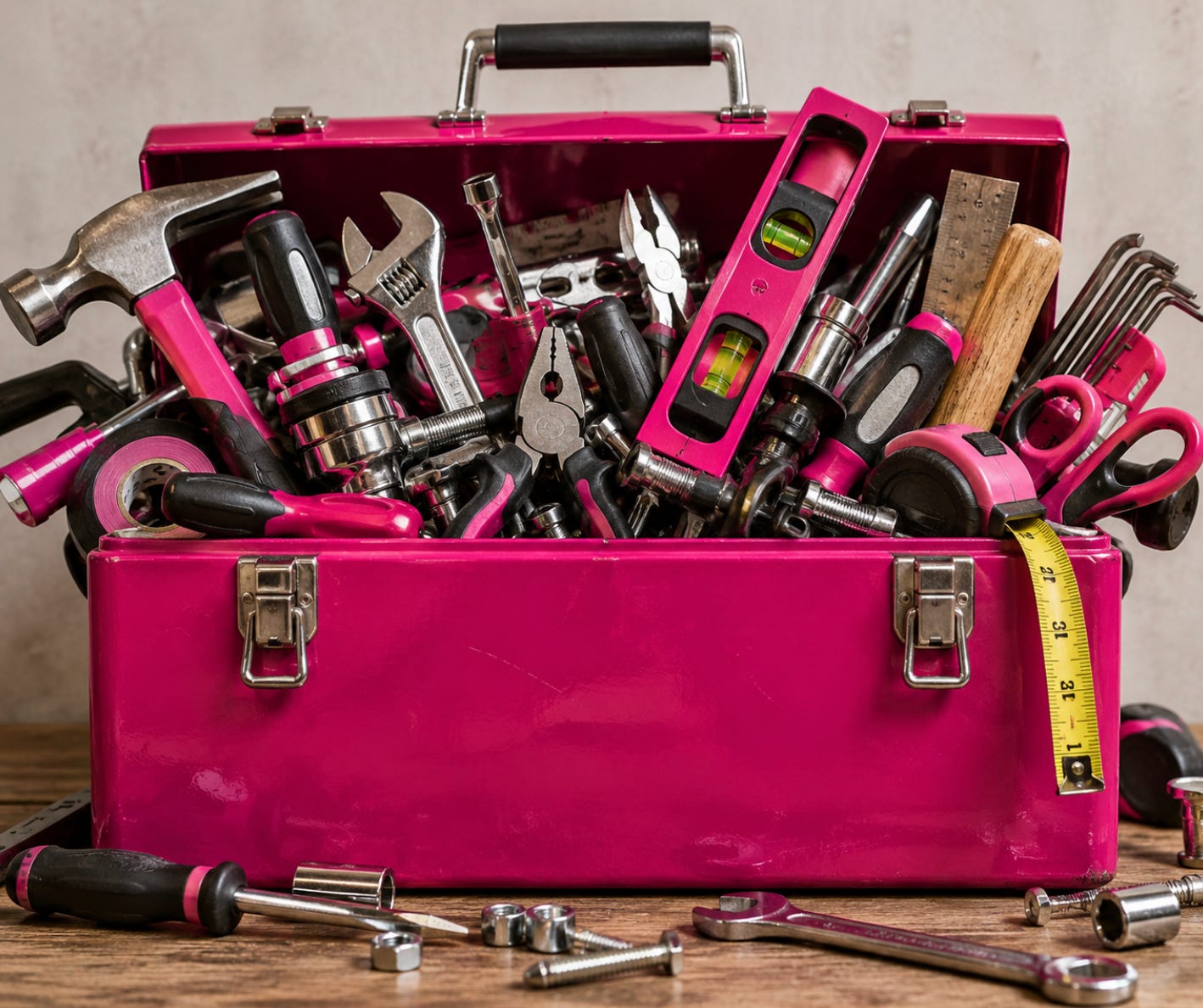
“It doesn’t matter if you have a million tools in your toolbox. You alone only have two hands.”
My client looked at me and said, essentially: You need to write about that.
So I did.
Because I think we have gotten something profoundly wrong about coping. We talk about coping skills as though the goal is to accumulate enough of them that eventually nothing will be too much.
Learn to regulate your nervous system. Learn boundaries. Learn distress tolerance. Learn to communicate more effectively. Learn to identify your triggers. Learn when to rest and when to push.
Learn mindfulness and grounding and self-compassion and cognitive restructuring and sensory regulation and pacing and breathing and tapping and reframing and whatever else someone has decided belongs in the very expensive toolbox you are apparently supposed to carry everywhere.
Some of those tools are excellent. I teach them. I use them. I believe in them.
But there is a point at which asking someone what coping skill they could use becomes almost insulting.
Because sometimes the problem isn’t that you don’t have the right tool. The problem is that you are carrying too much.
You can have the most beautifully stocked toolbox in the world and still only have two hands.
And if one hand is holding grief and the other is holding your job, where exactly should one put chronic illness, neurodivergent distress, relationship stress?
If one hand is holding parenting in one hand and the other is keeping a relationship from falling apart, which finger should hold financial stress?
Maybe you have trauma in the crook of your elbow. Maybe you’ve tucked sensory overwhelm under your chin. Maybe you’re balancing caregiving on your head while somebody hands you a breathing exercise.
At some point, this circus act becomes absurd. And yet this is so often how we conceptualize resilience.
We admire people for how much they can hold. Then, when they start dropping things, we teach them better gripping techniques.
I have been thinking more and more about the difference between skills and capacity. They are not the same thing. A person can be extraordinarily skilled and completely out of capacity.
In fact, some of the people who appear to be coping exceptionally well are using an astonishing amount of skill simply to remain upright.
This matters enormously for neurodivergent people, disabled people, traumatized people, caregivers, parents, people living in poverty, people navigating oppression, and anyone whose nervous system is already spending resources on things the people around them don’t have to consciously manage.
The outside world sees the thing being carried. It doesn’t necessarily see the carrying. It sees someone answer the email. It doesn’t see the hour of paralysis before it, sitting in a circle of children dysregulated and screaming, or the coffee knocked over while diving for a ringing phone as a doctor you’ve been trying to get ahold of all day calls back because you need your life saving medication on time.
It sees someone make dinner.
It doesn’t see the sensory overload, executive functioning, pain, decision-making, transitions, and cleanup bundled inside the seemingly simple task.
It sees someone get through the workday.
It doesn’t see what gets sacrificed afterward to make that possible.
And because the person can do the thing, we decide they have capacity for the thing. And they decide they should do the thing.
This is one of the places I think therapy has to be careful.
Therapy can become another institution asking people to increase their tolerance for intolerable circumstances. We can become so enamored with tools that we forget to ask whether our clients should have to keep carrying everything in the first place.
Sometimes the therapeutic intervention isn’t:
What skill could help you manage this?
Sometimes it is:
What can we put down?
What can someone else carry?
What demand can disappear?
What expectation was never reasonable?
What accommodation changes the weight?
What relationship needs to become reciprocal?
What system is benefiting from your ability to keep functioning beyond your capacity?
And perhaps the hardest question:
What if the fact that you could technically carry it doesn’t mean you should?
I think about this in my own life, too.
I know a lot of tools.
Occupational hazard, really.
I can analyze and contextualize and regulate and communicate and accommodate and problem-solve with the best of them.
And none of that turns me into a person with six hands.
There are times when the most psychologically healthy thing I can do is nothing. Or nothing with a soft blanket.
It is to acknowledge that I am at capacity.
Not because I failed to cope.
Because capacity is real.
Bodies have limits.
Nervous systems have limits.
Time has limits.
Attention has limits.
Even love has limits on what it can carry without reciprocity, rest, and repair.
There is something almost radical about recognizing this in a culture obsessed with optimization.
Because once we stop assuming every struggle is a skills deficit, different questions become possible.
Instead of:
How can you handle more?
We can ask:
Why are you carrying so much?
Instead of:
What tool haven’t you tried?
We can ask:
Who could take something out of your hands?
Instead of:
How do we make you more resilient?
We can ask:
What would make resilience less necessary here?
That doesn’t make tools useless.
It puts them back in their proper place.
A tool can help you do something.
A tool cannot give you another hand.
And maybe sometimes the most important thing I can offer someone in therapy isn’t another thing to put in their toolbox.
Maybe it is permission to set the toolbox down.