BLOG POST Support That Fits Us
I Don’t Fuck With Paris
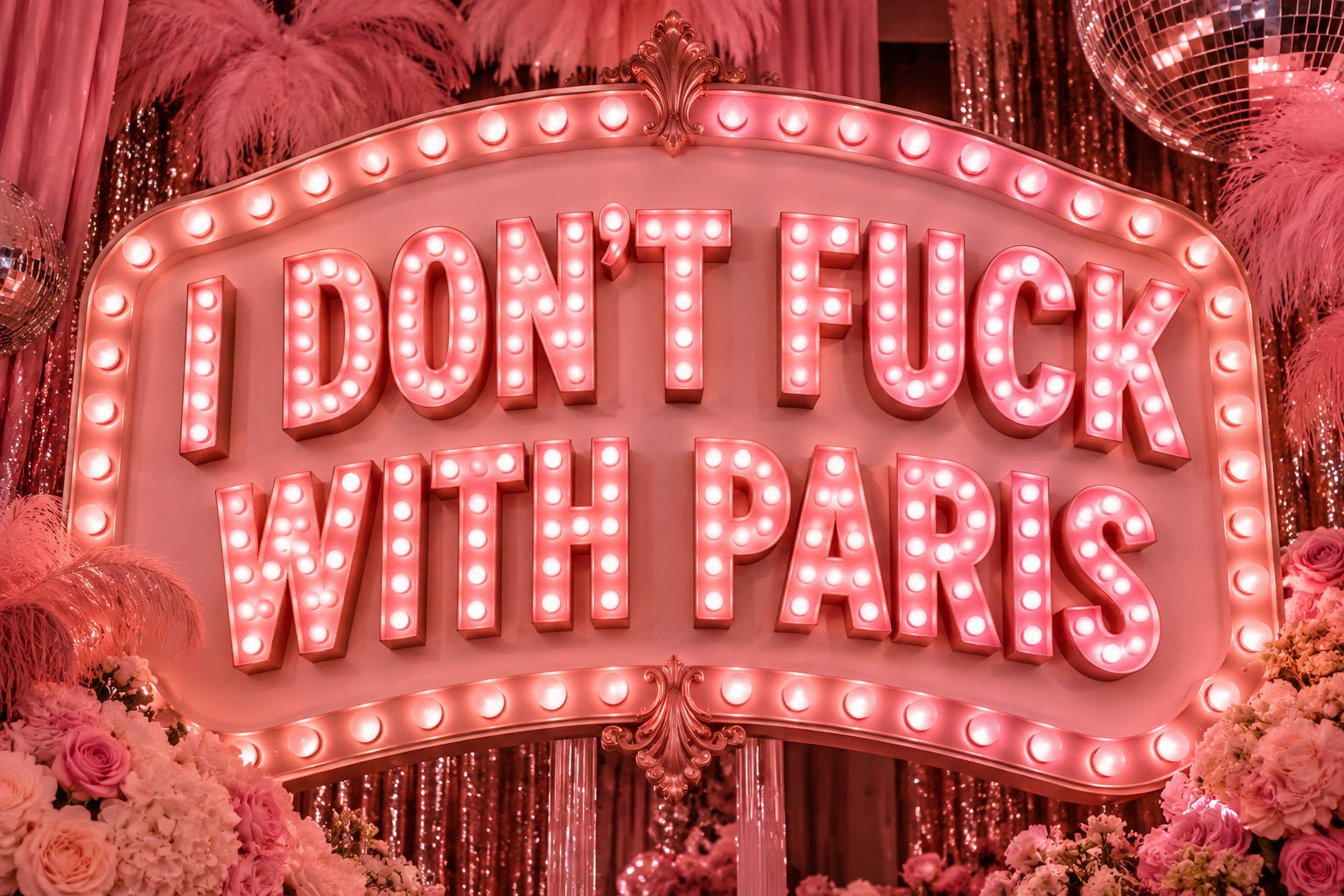
I wasn’t invited to Paris Hilton’s ADHD event. There was no dramatic refusal. No principled rejection of a pink invitation. No publicist desperately trying to reach me while I weighed my values against the possibility of fabulous sensory experiences.
Although, honestly, the sensory experiences looked pretty fucking great.
Breaking The Frame is a reader-supported publication. To receive new posts and support my work, consider becoming a free or paid subscriber.
The whole thing looked like a Los Angeles bat mitzvah with a celebrity budget, a neurodiversity consultant, and absolutely no adult supervision. And as someone who grew up in that world, I have to admit, I felt a little nostalgic.
If I could go back and redo my bat mitzvah, I’d probably make the theme Broadway and Neurodivergence. Which, in retrospect, would have explained a LOT about thirteen-year-old me. But several decades later, I suppose I’ll have to rely on Paris Hilton to show us what a neurodivergent-themed bash looks like.
All the elaborate decorations, sensory experiences, and social hierarchies of a Beverly Hills bat mitzvah. Just with fewer awkward slow dances and more people explaining their executive dysfunction on Instagram. And apparently, the guest list is still the most important part.
Some traditions really are timeless.
Watching coverage of UNSTOPPABLE, the October 15 ADHD creator summit hosted at Hilton’s home, brought up a lot for me. The idea was straightforward: gather influential neurodivergent creators, provide education and community, and use their platforms to spread more accurate information about ADHD.
I understand the strategy. I also understand the appeal. But I keep coming back to a question:
When did having influence become a qualification for representing a neurodivergent community?
And why are we so comfortable recreating the very social hierarchies that have excluded so many of us?
First, I Don’t Fuck With Paris Hilton
My discomfort with Paris Hilton isn’t some reflexive objection to a wealthy, successful woman. I love seeing women build extraordinary things. It’s rooted in her documented history of racist, homophobic, and antisemitic remarks.
That history matters to me as a queer Jewish woman who has spent years working in LGBTQ+ advocacy, sexual health, and community organizing.
Hilton has publicly expressed remorse for some of her past behavior. She’s also done meaningful work advocating against institutional abuse. And I believe her about what she experienced.
I believe her on her own terms, not because survivors need corroboration. But I also know people who were there with her. This history is closer to my own world than people might imagine.
I can believe Paris, respect her advocacy, and still hold her accountable for the harm she’s caused.
Her trauma doesn’t erase the harm. The harm doesn’t erase her trauma. Both deserve to be taken seriously.
I don’t believe accountability requires permanent exile. I believe in growth, change, and repair. But I also don’t believe that becoming an advocate means we move beyond questions about our own conduct.
And the people harmed by someone’s previous behavior don’t owe forgiveness simply because that person has a new public identity.
Accountability isn’t about choosing whose pain counts. It’s about making room for more than one person’s truth.
I Know This Room. Maybe a Little Too Well.
I grew up in Los Angeles, around that world, that crowd, those social circles. This world isn’t foreign to me. It’s the world I come from.
And here’s the thing: I know exactly how to hang with that crowd. I’m good at it. Really fucking good at it.
I know the social rules, the hierarchies, the humor, the references. I know how to read a room, make people laugh, hold my own, and move comfortably among people with money, status, influence, and power.
I know how to belong in those spaces. And I can do it so well that you might never know there’s anything complicated happening underneath.
Which brings me to masking.
We often talk about autistic and ADHD masking as something people do because they’re struggling socially. As though masking is always an awkward, exhausting attempt to blend in.
But sometimes masking is incredibly effective. Sometimes you become so good at performing a particular version of yourself that everyone around you believes it’s effortless. Sometimes you don’t just fit in.
You fucking excel.
And that’s what makes it complicated. Because the question isn’t whether I can belong in those rooms. I can. The question is whether the version of me who belongs there is the version of myself I most want to inhabit.
And the answer is no.
Not because that version of me is entirely fake. I genuinely enjoy the humor, the energy, the glamour, and some of the people. But I know what parts of myself become louder in those spaces, and what parts get quieter.
I know how easily I can slip into the dynamics of status, access, and being chosen. And I know how rewarding it can feel to be good at something, even when that something requires me to organize myself around values I no longer want to prioritize.
Sometimes the most effective mask isn’t the one that hides how much you’re struggling. It’s the one that makes you so successful at belonging that you stop asking whether you want to belong that way.
That’s part of what unmasking has meant for me. Not discovering that I can’t navigate certain spaces. Discovering that I can navigate them beautifully and still choose not to organize my life around them.
I can be charming. I can be entertaining. I can play the game. But I don’t owe every room the version of myself that knows how to win its approval. And I don’t owe myself a lifetime of performing something just because I’m exceptionally good at it.
I spent enough of my life learning how to succeed in rooms organized around status. I don’t want to spend my career recreating those rooms and calling them neuroaffirming.
Influence Is Not Representation
There is a legitimate argument for gathering influential neurodivergent creators. They reach people who may never read a research article, attend a conference, or seek out clinical education.
They can normalize conversations about ADHD, help people recognize their own neurotype, and connect people to resources. Some do extraordinary advocacy work.
But reach and representation are not the same thing. Neither are popularity and expertise. And neither are visibility and accountability.
When we organize neurodivergent advocacy around influence, we give people who have mastered the algorithms disproportionate access to conversations shaping public understanding.
What happens to the people who cannot reliably produce content? The autistic ADHDer who isn’t comfortable on camera? The PDAer for whom creating content on demand can become inaccessible?
The person living with chronic illness whose energy is spent navigating pain, fatigue, and medical systems? The person whose trauma makes public visibility unsafe?
The person who doesn’t have the money, time, or support to build a platform? Or the person who simply has no interest in turning their neurotype into a personal brand?
The ability to attract attention is not the same thing as the ability to understand, represent, or advocate for a community.
And when we build movements around the people who are easiest to see, we risk making the people with the greatest support needs invisible all over again.
What If We Measured Who Gained Power?
I understand the numbers game. I understand why organizers would want to gather creators with an enormous combined audience. That’s an opportunity to spread information.
But what if reach wasn’t our only measure of success? What if, instead of asking how many followers the invited creators already have, we asked:
How do we help people who have important things to say build the platforms they don’t yet have?
What if established creators mentored emerging advocates? What if organizers funded disabled people to participate, offered technical support, facilitated collaborations, and introduced people to audiences they couldn’t otherwise access?
What if we created opportunities for people who don’t want to be influencers to shape the decisions being made about their communities?
Because there’s a difference between gathering people who already have influence and using a gathering to redistribute it. One consolidates existing power. The other can create access to it.
And I’m much more interested in the second.
Not everyone needs a personal brand. Thank fucking God. But people deserve opportunities to be heard, influence decisions, and access resources without first proving they’re commercially valuable.
What if our measure of success wasn’t simply how many people we reached, but how many people we helped become reachable?
I don’t want us to stop measuring reach. I want us to start measuring whose reach we’re helping grow. And, even more importantly, whose power we’re willing to share.
Your ADHD Superpower Might Be Money
I actually love that some people experience aspects of their ADHD as superpowers. The creativity. The curiosity. The intensity. The unexpected connections. The energy that can come from being deeply engaged in something meaningful.
I don’t want to take that away from anyone. But superpower talk needs balance.
ADHD can be a source of extraordinary strengths and a profoundly disabling experience. Sometimes for the same person. Sometimes on the same day.
The problem isn’t celebrating what people love about their neurotype. The problem is when celebration becomes an expectation. When we suggest that ADHD is valuable because it makes people creative, entrepreneurial, innovative, or successful.
When we replace the old deficit narrative with a new demand to be exceptional. And when we tell stories about ADHD success without acknowledging the infrastructure supporting that success.
The entrepreneur whose ADHD makes them wildly creative. The celebrity whose unconventional brain helped them build an empire. The executive who turned their differences into a competitive advantage.
Great. I love that for you.
But can we talk about who handles the scheduling? The bills? The appointments? The travel? The household? The laundry? The things that happen when executive functioning isn’t particularly interested in cooperating?
Wealth doesn’t eliminate ADHD. But it can dramatically change the consequences of having it.
Money can purchase executive functioning support. It can buy flexibility, assistance, childcare, transportation, healthcare, and time. It can create a buffer between difficulty and disaster.
None of that means a wealthy ADHDer isn’t disabled. It means that our experiences of our neurotypes are shaped not only by our brains, but by the environments, resources, and support systems available to us.
If one person can pay someone to manage their calendar and another loses their job because they cannot manage theirs, we’re not simply looking at different levels of motivation. We’re looking at different levels of access.
And if we tell the second person that ADHD is a superpower without acknowledging those structural differences, we risk giving them one more reason to believe they’re failing.
I want people to celebrate what they love about their ADHD. I also want them to be allowed to say it’s hard. That sometimes it’s disabling. That sometimes they’re exhausted. That sometimes they don’t particularly like it.
Without someone insisting they reframe their struggle as a hidden gift.
Neuroaffirming doesn’t mean insisting that every aspect of neurodivergence is wonderful. It means making room for people to experience their neurotypes on their own terms.
I don’t need ADHD to be glamorous. I need people to access support without having to become exceptional first.
Power Without Accountability Is Not Community
Influence is power. The power to shape narratives. To influence what people believe about diagnoses, treatments, parenting, accommodations, and disability. To direct attention, resources, and opportunities.
To make someone visible. And sometimes, to make someone disappear.
When influencers become central figures in neurodivergent advocacy, we have to ask what accountability looks like.
What happens when they share misinformation? When someone with less power challenges them? When their behavior harms another disabled person?
When their commercial interests conflict with the needs of the people who trust them? When marginalized members of the community say, “This isn’t working for us”?
Are those people heard? Or are they dismissed as negative, divisive, jealous, or insufficiently supportive of someone supposedly doing so much good?
Accountability is not an attack on community. It is one of the ways we create community worth belonging to.
And this isn’t an accusation against everyone who attended the summit. I don’t know most of them, and I’m not interested in inventing wrongdoing.
It’s a question about the structures we build. If we’re giving people enormous influence over conversations about neurodivergence, what responsibilities come with that influence? And who gets to hold them accountable?
The Question of Who Gets the Microphone
After reading Dr. Leann Borneman’s essay about the summit, I found myself thinking about a more concrete example.
Borneman documented her outreach to organizers regarding Dr. Edward “Ned” Hallowell, a prominent ADHD psychiatrist whose involvement in the summit had been anticipated.
In October 2024, the Massachusetts Board of Registration in Medicine admonished Hallowell’s medical license after he admitted to making two sexually inappropriate comments to a patient and the patient’s partner that were unrelated to treatment.
This was documented professional discipline, not simply a disagreement over his opinions.
Borneman also discusses an older allegation of inappropriate touching in a criminal case that was dismissed in 2016 without a conviction. Both the allegation and the dismissal matter.
According to Borneman, she sent organizers information about the disciplinary history before the summit and received no response. She reports that attendees later told her Hallowell was present but did not speak.
I don’t know what organizers knew, what conversations happened privately, or whether his role changed because of those concerns. And I’m not going to pretend I do.
But as a psychotherapist, I find the underlying question important.
When someone brings documented concerns about professional boundaries into a space dedicated to mental health advocacy, what responsibility do organizers have to engage with those concerns?
Not necessarily to reach the conclusion every critic wants. Not necessarily to exclude someone permanently.
But to have a process. To examine the evidence. To consider the people potentially affected. To make decisions about safety and accountability that can withstand scrutiny.
That’s not demanding perfection. That’s asking people with power to use it responsibly.
A beautiful experience doesn’t erase an unanswered question.
RSD Is Real. So Is Impact.
I think we need to become much more comfortable talking about accountability in neurodivergent spaces without treating accountability itself as inherently harmful.
For many ADHDers, perceived rejection can be profoundly painful. Viscerally, physically, nervous-system-hijacking painful.
Rejection sensitive dysphoria, or RSD, is a term used to describe these experiences, rather than a universally established standalone diagnosis. And not every ADHDer experiences it. But for people who do, the intensity can be enormous.
I understand how difficult it can be to stay connected to yourself when something feels like rejection. And I also understand that the intensity of our emotional response does not determine the legitimacy of someone else’s experience of harm.
We can be devastated by being told we’ve hurt someone. And still have hurt them. We can act from ignorance rather than malice. And our actions can still have consequences.
We can be genuinely good people who care deeply about others. And still get things spectacularly fucking wrong.
Intent matters. Impact matters. But intent does not erase impact.
When someone has significant social power, their emotional response to criticism cannot automatically become more important than the concern being raised.
Otherwise, we create a dynamic in which the person with the greatest influence becomes the person whose feelings everyone else is responsible for protecting.
That’s not emotional safety. That’s a power imbalance.
I want neurodivergent communities to develop approaches to accountability that recognize disability. That allow time to regulate. That make room for misunderstanding. That reject public humiliation as the default response to mistakes.
But emotional discomfort is not necessarily evidence that someone is being harmed.
Sometimes discomfort is what happens when we discover that our understanding of ourselves is incomplete. Sometimes it’s what happens when someone else’s experience challenges our intentions. Sometimes it’s the beginning of repair.
And there’s a difference between not knowing something was harmful and refusing to engage once someone tells you.
Understanding our nervous systems, trauma histories, and neurotypes can help us repair harm. It doesn’t make repair unnecessary.
We can make accountability accessible without making it optional.
A Community Is Not a Marketing Demographic
One of the things that fascinates me about the neurodiversity movement is how quickly the language of liberation can be absorbed into capitalism.
Suddenly we’re not talking about accessibility. We’re talking about innovation. We’re not talking about support needs. We’re talking about unlocking potential.
We’re not talking about systemic barriers. We’re talking about helping people thrive.
And we’re definitely talking about products. Lots and lots of products.
Now, I love a good accessibility product. I have purchased more than my fair share of things designed to make my nervous system happier. I am not above being delighted by an excellent sensory tool.
But there is something worth examining when neurodivergent communities become attractive consumer demographics.
When belonging becomes an experience. When advocacy becomes a campaign. When neurotypes become marketing identities. And when participation is organized around people’s ability to generate attention.
I don’t believe commercial partnerships are inherently exploitative. Companies can fund meaningful accessibility initiatives. Creators can be compensated. Advocates can build successful businesses.
I have a business. I understand that meaningful work and earning a living aren’t mutually exclusive.
But the interests of a brand and the interests of a community aren’t automatically the same.
Brands want reach. Communities need trust. Brands want compelling stories. Communities need complicated truths. Brands want positive associations. Communities need room for anger, grief, disagreement, and accountability.
Sometimes the most important thing a community needs to say doesn’t fit neatly into a marketing campaign.
Sometimes the truth isn’t inspirational. Sometimes it isn’t marketable. Sometimes it makes people uncomfortable.
And sometimes the people who most need to be heard are the people least able or willing to turn their experiences into content.
I Don’t Want a Better Version of the Same Hierarchy
I spend a lot of time thinking about power in my work as a psychotherapist, educator, and advocate.
About how compliance gets mistaken for wellness. About how support becomes conditional on someone’s ability to perform a version of disability other people find understandable. And about how often the people most impacted by a system have the least influence over how it operates.
This isn’t unique to ADHD advocacy. It’s everywhere. In therapy. In education. In nonprofit organizations. In professional conferences. Even in movements explicitly committed to inclusion.
We can use all the right language and still recreate the same hierarchies.
We can talk about autonomy while making decisions without the people affected. We can celebrate diversity while rewarding the people who are easiest to understand.
We can proclaim that every voice matters while handing the microphone to the same kinds of people. And we can build beautiful, affirming spaces accessible primarily to people who already have access.
That last one really gets me.
Because I don’t want a more inclusive version of the same old hierarchy. I want us to question why it exists.
I want researchers, clinicians, organizers, artists, advocates, and people with significant support needs shaping conversations together.
I want the people whose lives have been most affected by disabling systems to have actual decision-making power. I want us to fund participation, not simply reward popularity.
I want accountability to be something we practice, not something we put in a mission statement.
And I want people who cannot be productive, marketable, entertaining, or inspirational to be just as central to our understanding of neurodivergence as people who can.
I don’t want an ADHD movement where the people with the most followers get to define inclusion, the people with the most power get to define accountability, and the people most impacted are expected to be grateful for the visibility.
I Know How to Get Into Those Rooms. That’s Not the Point.
Here’s something else I want to be clear about.
I know how I could have pursued a place on that guest list. I have direct access. I know people. I understand the networks, the relationships, and how invitations happen.
And I’m not going to pretend otherwise.
I know how to play that game. The fact that I can doesn’t mean I think everyone should have to.
I have access to power that other people in my community do not. That matters.
Some people have the relationships, credentials, money, social fluency, or cultural capital to get their foot in the door. Others have spent decades doing extraordinary work without ever being given the opportunity to meet the person holding the guest list.
I don’t think my access makes me more deserving. I think it gives me more responsibility.
And that’s where solidarity comes in.
Because I don’t live in solidarity with my community only when someone asks me to. I don’t wait for an invitation to care about whose voices are missing.
And I don’t believe that having the opportunity to benefit from an exclusive system obligates me to stop questioning it.
That doesn’t mean I speak for everyone. It doesn’t mean I get to decide what other neurodivergent people need. And it certainly doesn’t mean I always get it right.
Solidarity also requires listening, humility, and recognizing when my own assumptions are shaped by the privilege I’m trying to challenge.
But it does mean being willing to examine the systems I can personally benefit from. Even when nobody asks. Even when participating would be fun, flattering, professionally advantageous, or make for some really excellent Instagram content.
Because if my commitment to disability justice only exists when it doesn’t cost me access, then what exactly am I committed to?
I don’t want to be the person who gets into the room and forgets to ask why everyone else is outside. I don’t want to confuse my own inclusion with collective progress.
And I don’t want to build a career advocating for people whose exclusion I’m willing to overlook the moment I’m offered a seat at the table.
I know how to get into those rooms. What matters to me now is what I do with that knowledge.
I don’t want to be exceptional enough to be included in an exclusive community. I want us to stop treating exclusivity as evidence that a community is worth belonging to.
So Why Wasn’t I There?
Because I wasn’t invited.
And let’s be clear: not receiving an invitation isn’t a moral accomplishment. I don’t get to claim a principled stand over an invitation I never had to decide whether to accept.
I also don’t believe everyone who attended should be held responsible for every decision made by the organizers. People can have beautiful, meaningful experiences in spaces that still deserve criticism. Both things can be true.
But the social dynamics surrounding this event brought me back to a world where being chosen meant something. Where access was currency. Where proximity to powerful people could be mistaken for belonging.
And where fitting in sometimes meant learning to look away from things that made you uncomfortable.
I’ve spent a lot of my adult life unlearning that.
Learning that I don’t have to perform the values of people whose approval I once wanted. Learning that being seen isn’t the same thing as being known.
Learning that belonging which requires abandoning myself isn’t the kind of belonging I want. And learning that I can appreciate someone else’s success without needing access to the spaces where that success is celebrated.
I want neurodivergent people to be celebrated. But even more than that, I want them to be supported.
When they’re successful. When they’re struggling. When they’re delightful company.
When they’re messy, complicated, inconvenient, and unable to make their experiences inspirational.
When their neurotype doesn’t come with a marketable upside. When they’re not particularly good at being influential.
Especially then.
Because the goal was never supposed to be making neurodivergence more marketable.
The goal was supposed to be making the world more livable for neurodivergent people.
I wasn’t at Paris Hilton’s ADHD event because I wasn’t invited. But I know how I could have pursued a place there.
And that’s exactly the point.
I don’t want my access to power to become another reason I stop questioning it. I want to use whatever access I have to help build something that doesn’t require other people to have the same connections.
Because solidarity isn’t something I perform when my community asks for it. It’s something I choose in how I move through the world, including when nobody is watching.
I don’t need to be invited into every room. I need to know I’m not abandoning my community to get into one.
And I don’t fuck with anything that asks me to do otherwise.
Sources:
Dr. Leann Borneman (October 18, 2026). I Have a Lot of Feelings About Paris Hilton’s ADHD Summit. Her reporting informed the discussion of Ned Hallowell’s anticipated involvement, her outreach to organizers, and questions about professional accountability.
Massachusetts Board of Registration in Medicine (October 24, 2024). Massachusetts Board of Medicine Takes Disciplinary Action. Official confirmation of disciplinary action involving Hallowell.
Massachusetts Board of Registration in Medicine (October 21, 2024). Consent Order for Dr. Edward Hallowell. Primary documentation of the admitted conduct and sanction.
Understood.org (October 5, 2026). Paris Hilton to Host UNSTOPPABLE ADHD Creator Summit. The organizers’ description of the summit and its educational goals.
Los Angeles Times (September 21, 2012). Paris Hilton Apologizes for Gay Comments. Reporting on Hilton’s comments and public response.
PinkNews (March 20, 2023). Reporting on Paris Hilton’s Past Racist and Homophobic Comments. Context on her past remarks and public discussion of them.
Breaking The Frame is a reader-supported publication. To receive new posts and support my work, consider becoming a free or paid subscriber.