BLOG POST Support That Fits Us
I Don’t Look Disabled. Whatever the Fuck That Means.
*A large number of neurodivergent folks are living with dynamic disabilities - diagnosed or not so while this does not speak to the overlap, it truly is about what so many neurocomplex folks are living.
For a long time, I thought the goal was not to need the disability placard. Or, more precisely, to need it as little as possible.
Breaking The Frame is a reader-supported publication. To receive new posts and support my work, consider becoming a free or paid subscriber.
I could walk from the far end of the parking lot. So I should, right? I could make it across the enormous garage, through the building, down the hallway, and still arrive wherever I was going on my own two feet. So I should, right?
I could tolerate the dizziness. Push through the pain. Ignore my heart pounding harder than the task seemed to warrant. I could arrive at my destination standing, look at another person, and realize my brain could no longer interpret their words. I could be blacking out and still get through it, mask it, make it work.
The so I shoulds get a little harder to say when you put it that way.
For a long time, I can do it was the standard I used to determine whether I was allowed not to. I learned that long before I knew I was disabled.
I grew up fat in the 1980s and 90s, when the world was obsessed with an “obesity epidemic” it believed needed to be solved. Bodies like mine were treated as both problem and evidence. Movement wasn’t just movement. It was virtue. Effort was virtue. Taking the stairs was good. Walking farther was good. Choosing ease when exertion was available carried its own moral suspicion.
The fat kid was supposed to move. To prove they could. The fat kid was certainly not supposed to ask for a shorter walk. And if it hurt? Well, wasn’t discomfort sort of the point? That was my introduction to having a body in the first place.
There is a particular education that happens when the world has been trying to fix your body since before you understood there was anything supposedly wrong with it. You learn that pushing your body is admirable and listening to it is suspect. Decades later, hand me a disability placard and apparently some part of me still believes I should earn the right to use it by first proving how far I can walk without it.
The strange thing is that I did not get my placard at some moment of mild inconvenience. I got mine during a period when my body had nearly crumbled to the ground.
A doctor looked at what was happening to my body and signed the paperwork. Someone whose job included assessing medical need said, in the most literal bureaucratic way possible: Yes. You need this.
And it was true.
I could barely exist consciously without screaming. I have a genetically noted high pain tolerance. I was the kid whose mother had her tested to see if she had that disorder where you don’t feel pain. (I do not. I absolutely feel it.) My body was doing things I did not yet understand. A syndrome I had decided I didn’t have would later turn out to fit into a much larger constellation of things that had been happening my whole life.
My body knew before I did. My doctor knew enough to sign. The state agreed. A placard arrived.
You would think that would have settled it.
It didn’t.
Because apparently internalized ableism is stronger than paperwork. And when it falls on the back of a life exposed to a society inclined to yell “you’re fat” out car windows—well, let’s just say I have had enough therapy to know that therapy alone isn’t going to fix that.
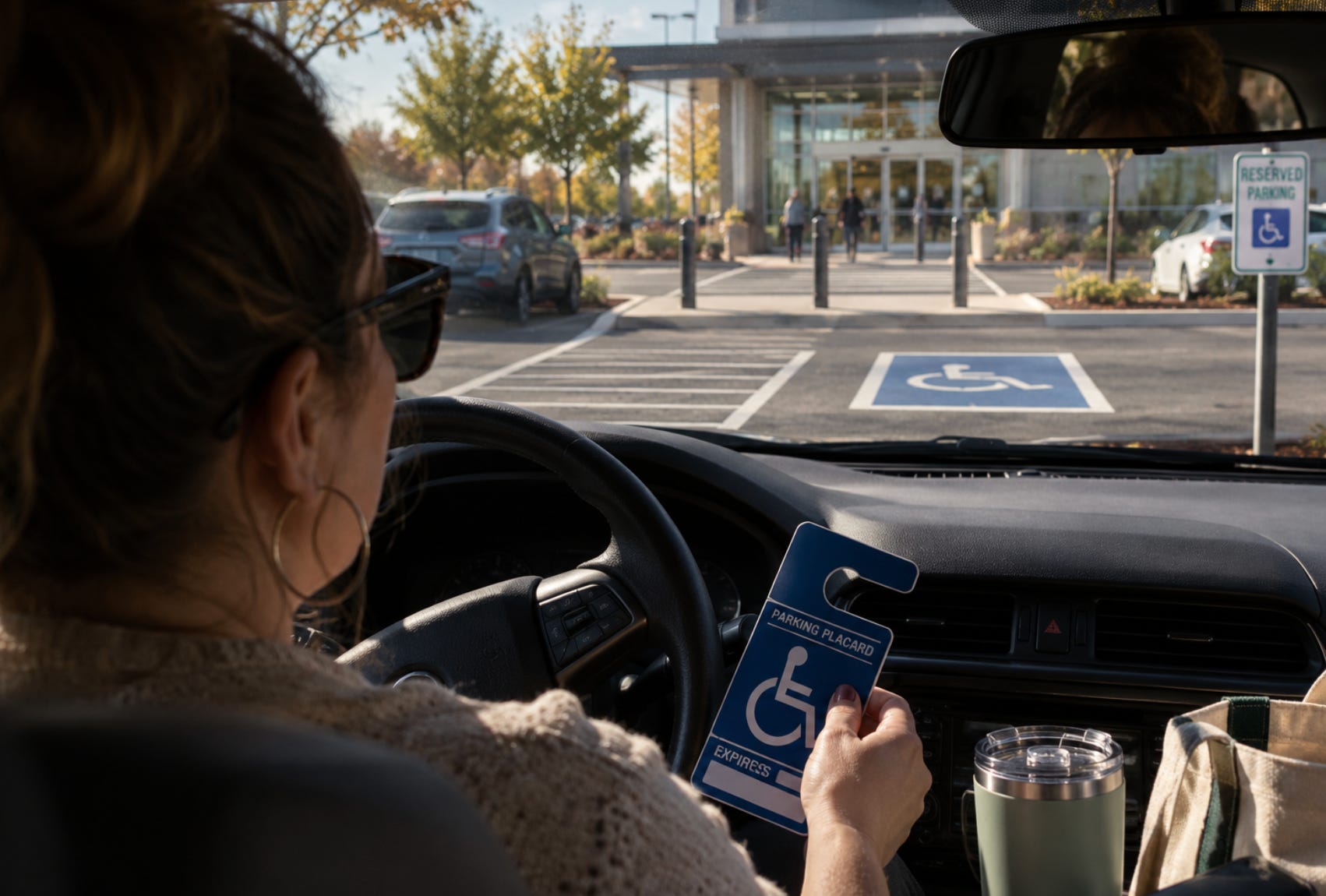
I can have a legally issued disability placard and still sit in the driver’s seat negotiating with myself about whether I am disabled enough to use the parking space it permits me to use.
And other people negotiate my disability too.
Recently I was pulling into an accessible space to run in somewhere and get food. Another car pulled into the lot and the driver started honking wildly at me. I didn’t have the tag hanging yet because you’re not supposed to drive with it hanging. I pull into the space and then hang it—the way you’re supposed to.
But what he saw was me. Young enough that society doesn’t expect me to be disabled. Bopping to music. Is there a stereotype that disabled people don’t do this? Apparently there might be. Just a middle-aged professional therapist and mom trying to get some lunch.
After my duck-and-cover reaction to the horn, I looked over. He was gesticulating wildly, making sure I understood that this was a space for disabled people.
There was an immediate flash of guilt.
And then it disappeared.
Because who the fuck was this dude to decide?
I picked up my placard. I smiled at him. I held it where he could see it. Then I pulled into my spot with adrenaline coursing through my body.
And cried.
One hour of my day. One parking space. One completely ordinary task. And still I cannot exist outside a paradigm in which other people believe they know what disability is supposed to look like.
I can know what my body has survived and still wonder whether today is bad enough. I can remember the version of myself whose body was nearly crumbling and somehow use her as evidence against the body I live in now: You’re doing better than that. You can walk today. You don’t really need it this time.
Internalized ableism is deep. It is remarkably difficult to mobilize your way out of.
This is one problem with dynamic disability. If I could not walk across a parking lot, the decision would be simpler.
But I can. Most of the time.
The problem has almost never been whether I can do one thing. The problem is what happens when every single thing costs something.
Walking across the parking lot costs something. Standing in line costs something. Heat costs something. Carrying bags costs something. Holding my body upright costs something. A bad night’s sleep costs something. An unexpected staircase costs something. Parenting costs something. Working costs something. Being present with the people I love costs something.
None of those costs, by themselves, necessarily looks catastrophic.
That is precisely the problem.
Can you walk that far? Yes. Can you climb those stairs? Probably. Can you go into the store? Yes. Can you take your kid to this thing? Yes. Can you work today? Yes.
But my body does not reset between questions.
The body runs the total. Sometimes across hours. Sometimes days. Sometimes weeks.
The parking lot does not disappear from the equation because I successfully crossed it. The stairs do not refund the energy I spent climbing them. I have passed out, gotten myself back up, and continued because I saw no other choice. I have been in severe pain because I left my bed while knowing that staying in bed would create its own problems.
Each event can be survivable. I can usually do the thing.
But the thing is never only the thing. It becomes part of the conditions under which I have to do the next thing.
Maybe that is another reason the fatness matters here. I was raised in a culture that taught me to evaluate physical effort one task at a time. Could you walk instead of drive? Take the stairs? Exercise longer? Push harder? Could you just not eat? Then you should.
I had a trainer by late elementary school on top of dancing almost daily. The possibility of movement became an argument for movement. Nobody was asking what the movement cost afterward. The objective was expenditure itself.
Eventually I started asking a different question. Not: Can I walk from there? But: What am I saving that walk for?
Because walking farther through a parking lot is rarely the thing I care about.
I care about having enough capacity to parent. I care about working and still having something left after. I care about going somewhere with my children without the logistics of getting there consuming the energy I needed to actually be there with them. I care about conversations. Laughing. Thinking. Writing. Loving people. Participating in my own life.
I am no longer particularly interested in spending my body merely to prove I was capable of spending it.
Capacity conserved in one place becomes possibility somewhere else.
The placard doesn’t make me less capable. It lets me choose where my capability goes.
And yet I don’t “look disabled.”
Whatever that means.
When I used to teach yoga, run, spend every day of the week dancing—I was disabled then too. The hardest part about the intense meditation I did at that point was the searing pain I endured sitting for that long. I was disabled; I just wasn’t as keenly aware of it as I would later become. Time and unintended harm have a way of revealing what you don’t already know.
There is something particularly complicated about being fat and invisibly disabled. A fat person moving easily can become evidence that she isn’t disabled. A fat person struggling to move can become evidence, in someone else’s mind, that she simply needs to move more. And while I currently live with size privilege, I carry the metaphorical weight of someone who has not always.
My body does not reliably offer strangers whatever evidence of disability they expect. Sometimes I get out of the car and walk normally. Sometimes I am dressed up. Sometimes I am laughing with my children. Sometimes I am moving quickly because moving quickly is possible right then—and frankly, moving quickly is often easier for me than moving slowly.
But explain that to a rando in a parking lot who thinks it’s his day to police other people’s bodies.
Or don’t.
Bro doesn’t need an explanation.
Sometimes the reason I am having enough of a body day to move through the world at all is because I have been conserving capacity in places exactly like this one.
When people say someone doesn’t “look disabled,” what they often mean is that they cannot immediately see a disability they understand. Somehow that gap in their knowledge gets converted into suspicion of the disabled person rather than humility about the limits of what can be known by looking.
I don’t owe anyone a performance that makes my body legible enough for them.
There is a particular kind of pride available to dynamically disabled people: the pride of proving that we don’t really need what we have been given. Look. I parked in the regular spot. I took the stairs. I didn’t sit down. I carried it myself. I didn’t ask anyone to accommodate me. Look how little trouble my disability causes everyone.
Except eventually I arrive with less. Less capacity to parent. Less capacity to work. Less capacity for patience and thought and connection. Less of myself available for the life I was supposedly proving I was capable of living.
This is where the lessons of fatness and disability become almost impossible for me to separate. I learned young that making my body work harder was morally good, though I no longer believe that.
I am learning now that making my life unnecessarily harder is not.
There is no virtue in spending capacity simply because the opportunity to spend it exists.
Sometimes I see an accessible parking space and think: Someone might need that more.
There almost certainly is someone who does. But I do not have to wait until using the accessible space is the only way I can enter the building.
Because by then, we have confused accommodation with emergency intervention.
An accommodation is supposed to come before the collapse.
I know what collapse looks like. I have lived it.
Perhaps one of the strangest things about getting better at living in a disabled body is that the things helping you stay upright can begin to look, even to you, like evidence that you no longer need them.
But prevention working is not proof that prevention was unnecessary.
My placard is not an award for being unable to walk. It is infrastructure. It does not certify my incapacity.
It preserves my capacity.
And what strikes me now is how rare that is. There is no reserved space for the energy I lost sleeping badly. No shorter line because my body has already been working overtime. No legal protection against the twelve tiny expenditures that came before I reached the grocery store.
But here, strangely, there is.
A little piece of plastic hanging from my rearview mirror. A parking space. A few hundred feet I do not have to spend.
One place where the law allows something not to accumulate.
I am learning that someone else’s inability to see my disability does not create an obligation for me to make it visible. That being able to walk from a parking space does not mean walking from every parking space costs the same thing. That being disabled and having a good day are not contradictions. That needing less support today than I did when my doctor signed that form does not mean I need no support now.
Mostly, I am learning that I do not have to spend everything I have simply because I can survive spending it.
I don’t have to make walking across that parking lot the thing I succeed at that day.
I would rather succeed at being present when my kid tells me something that matters. I would rather work and write and laugh and travel and show up for the people I love.
I would rather spend my body on my life.
So I am learning to hang the placard. Even on days when I could walk farther. Even on days when I look, to someone else, like I don’t need it. Especially on days when there are many other things I want to be able to do.
Because disability isn’t always the thing that stops you.
Sometimes disability is the arithmetic you have to do to keep going.
Access is not about proving that one task is impossible. Sometimes access is simply refusing to let every unnecessary difficulty accumulate until living your actual life becomes the impossible task.
The parking space is not the destination. It is what lets me arrive with more of myself still available.
I don’t need to look disabled. Whatever that fucking means.
I don’t need to prove I couldn’t have walked farther. I don’t need to wait until my body nearly crumbles to the ground again to believe what it already taught me.
I don’t have to prove I can get there the hard way in order to deserve to be there at all.
Breaking The Frame is a reader-supported publication. To receive new posts and support my work, consider becoming a free or paid subscriber.